Culture Politics Religion Periodicals Organizations Miscellaneous

Table of Contents

   Index
   Kashmiri Writers
   Download in pdf format


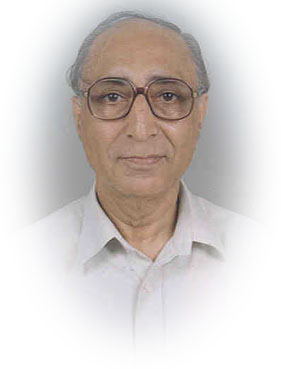
Triloki Nath Dhar 'Kundan'

Triloki Nath Dhar Kundan

Sh. T. N. Dhar 'Kundan' has written exclusively on Kashmir, its political scenario and religious practices of its original inhabitants, the Kashmiri Pandits, and has authored several books on a variety of socio-cultural topics. For a number of years, he served as an editor to Koshur Samachar, a tri-lingual publication of Kashmir Samiti, New Delhi. We at KNN are indebted to him for sharing some of his articles with our readers.

List of books written by T.N. Dhar

English
1. A Portrait of Indian Culture published by Rashtriya
Sanskrit Sansthan.
2. A Window on Kashmir
3. Bhagavad Gita, the Elixir of Life
4. Exploring the Mysterious
5. Understanding Education
6. Philosophy of a Common Man
7. Saints and Sages of Kashmir
8. The Saint Extra-Ordinary, Bhagavaan Gopinath

Serial No. 2,3 and 4 published by Mittal Publishers, Ansari Road, Darya Gunj New Delhi. Serial No. 5 and 6 published by Rajat Publishers, Ansari Road, Darya Gunj, New Delhi. No.7 published by Bhagavaan Gopinath Trust and No 8 by A.P.H. Publishing Corporation, Ansari Road, New Delhi.

Hindi
1. Main Pyasa Hun (I am Thirsty) - A collection
of Hindi Poems
2. Main Samudra Hun (I am an Ocean) A collection of
Hindi Poems
3. Guru Se Samvad (Dialogue with a Preceptor)

Kashmiri
1. Swapna ta Sonch (A Dream and a Thought) A
collection of Kashmiri Poems.

In addition two more books in English, ‘Kashmiri Pandit Community- a Profile’ and ‘On the Path of Spirituality’ are under print being published by the Mittal Publishers, Ansari Road, New Delhi.

Featured Collections

Batanya, an Apostle of Womanhood
Whenever I hear the epithet ‘Batanya’ for a Kashmir Pandit lady two different pictures emerge on the canvas of my vision. I shall try to describe both but before I do, let me trace the origin of this word.   >>>
Who Fights Whom and Why
Shrimad Bhagawad Gita is said to  be a discourse delivered by the Lord for Arjuna, while the two armies of Kauravas and Pandavas were arrayed against each other in the battle- field of Kurukshetra.   >>>
I am a Kashmiri Pandit and my faith is ‘Sanatana Dharma’, the eternal law. I have been living in this land, Kashmir for so many millennia.   >>>
Jagad Guru Bhagavaan Gopi Nath ji
It is by now an open secret and a matter of common knowledge that the officers and personnel of the Indian Army, who had never even heard of him saw Bhagavaan Gopi Nath Ji at the front during Kargil conflict with Pakistan Army, guiding them during the operations.   >>>
 
The Kashmir Shaiva Philosophy
Kashmir Shaiva Philosophy is basically a non-dualistic philosophy wherein such a Supreme Truth has been conceived which is at once non-changeable, in-divisible, infinite, endless and transcending time, space and form, which is all pervading, yet above everything.  >>>
‘Laer’, a Typical Kashmiri House
Enter the courtyard, with or without a gate, of any house anywhere in Kashmir and you will see an open rectangular or square space kept as neat as the weather permits.  >>>
Lyricism in Nadim’s Poetry
At the outset let me make it clear that I am not a critic. I did not aspire to be one for fear of inviting the comment of Alexander Pope that ‘those who fail as poets become critics’. I am a poet and, therefore, I shall make my observations about Nadim’s poetry as a poet only.  >>>
Divinity, the Geeta Way 
Swami Vivekananda’s mission was to raise man from animality to divinity. He emphasised that divinity should be made manifest in every movement of his life. The Geeta in chapter XVI has summed up, in just two and a half shlokas, the traits of divinity and explained in detail the various traits of animality.  >>>
From Grief to Renunciation
Sometimes I wonder why Shri Krishna had to give to Arjuna, after a long discourse running into eighteen chapters of the Geeta, what all was available to the Gopis right from the beginning. For an answer to this question, again I turn to the Geeta itself.  >>>
Yoga in the Bhagwad Geeta
In the last five verses of the Geeta, Sanjaya sums up the dialogue between Arjuna and Shri Krishna. It is significant to note that he refers to Shri Krishna as ‘Yogeshwara’, the lord of yoga. What is meant by yoga?  >>>
Shiva the Multi-Faceted Lord 
Of the three cults prevalent in India, those of Shiva, Shakti and Vishnu, the most common is the Shiva Cult. Even those, whose deity is Vishnu, must worship Ganesha at the outset, who is one of the two sons of Shiva. Those who follow Shakti cult also believe that Shiva and Shakti are inseparable. >>>
The Secret of Shivratri
Shiva is the eternal existence and, therefore, the Supreme Truth. He is free of bondage, devoid of attributes, all pervading and yet above everything, ‘Ati tishthat dashangulam’. He is Consciousness, ‘Chita’ and Bliss, ‘Ananda’.  >>>
The Steadfast and the Loved One
A divine poetry, as the Bhagwad Gita is, it is interesting to note, that it is written in conversational form. Conversation between Sri Krishna and Arjuna, which forms the core content and conversation between Sanjay and Dhritrashtra that narrates and reproduces the whole dialogue.  >>>
The Systems of Indian Philosophy
Philosophy, says Bertrand Russell, is a No Man’s Land between theology and science. Dogma is the realm of theology and definite knowledge that of science. The Sanskrit word for philosophy is Darshan, which means ‘seeing’.  >>>
Terrorism and Kashmiri Pandits
Once we were having a seminar on Kashmiri Language and Literature in New Delhi. As was expected, various aspects of the language, its development, present position and future prospects were discussed.  >>>
The Elixir of Life
A detailed study of the Gita will show that often there is no single straight answer to any single straight question. This is not surprising. Since the dawn of civilisation the life itself has been so complex and intricate that the problems faced by the mankind and their solutions cannot be over simplified.   >>>
The Upanishads
“Jnani Twatmaiva Me Matam, B.G.7.18- A knowledgeable one is my very soul,” proclaims Shri Krishna in the Bhagwad Gita. In order to become knowledgeable one has to acquire knowledge. Vedas are the store house of knowledge, but then there is a lot of other matter in the Vedas; ... >>>
Marriages, outside The Community
Ours is a very small community, a miniscule one, scattered all over the country and even abroad. We go by the nomenclature 'Kashmiri Pandits'. Prior to 1990 we were largely concentrated in the valley and those who were outside also had their roots in the valley. 
>>>
Five Millennia Old Culture & Literature of Kashmir
It is in the fitness of things that today when the twenty-first century is knocking at our doors and when our beloved Kashmir is undergoing an unprecedented turmoil for more than a decade now, we should be sitting back and reflecting on the five millennia old culture and literature of Kashmir, the land of our birth.  >>>
The Festivals of the Kashmiri Pandits
Kashmir is known as the abode of Rishis because it has provided a calm and serene shelter to sages and savants for their penance. In the hoary past, it was inhabited by the Nagas as is vouched by Nila in his Nilmat Purana and Kalhana in his Rajatarangini.  >>>
sópún tû sònch
 

 | Home | Copyrights | Disclaimer | Privacy Statement | Credits | Site Map | Links Contact |
Copyrights
© 2005-2010 Kashmir News Network (KNN). All Rights Reserved.
Any content available on this site should NOT be copied or reproduced in any form or context without the written permission of KNN. This site is designed, developed and maintained by
Sunil Fotedar..